Our pump budget overran three years in a row. Not catastrophically — roughly 8% the first year, closer to 14% the second — but enough that our finance lead started asking me to walk her through every invoice over $500. That is not a conversation I enjoy having twice.
Here's what made it confusing: our unit prices were fine. We ran three quotes on almost everything, our buyers negotiated, and on paper we were paying market rate. If I remember correctly (this was back in 2022, before we changed systems), our average centrifugal pump purchase landed within about 4% of the lowest published distributor quote. I checked that obsessively for a while.
So for the first year and a half I blamed demand. Bad luck. An aging building portfolio. More failures than usual.
That was wrong. The problem wasn't the price we paid for pumps. It was that we were comparing things that only looked comparable.
From the outside, two quotes for "the same pump" look like a price difference. The reality is that one quote is for a pump, and the other is for a pump plus the fifteen small decisions that determine whether it's still running in three years.
Why the quote sheet lies to you
I want to be specific here, because "total cost of ownership" gets thrown around as a slogan and stops meaning anything.
1. The model number drifts, and nobody flags it
You spec a 2-inch sewage ejector pump for a basement lift station. Vendor A quotes the model you asked for. Vendor B quotes something "equivalent" — same horsepower, same discharge size, different impeller trim, different solids-handling capability, sometimes a different motor enclosure rating. The B quote comes in 18% lower. It gets selected.
Six months later you're standing in a mechanical room with a pump that clogs on the same debris the original unit handled, and the argument about whether it was "equivalent" costs you more in staff time than the savings were ever worth.
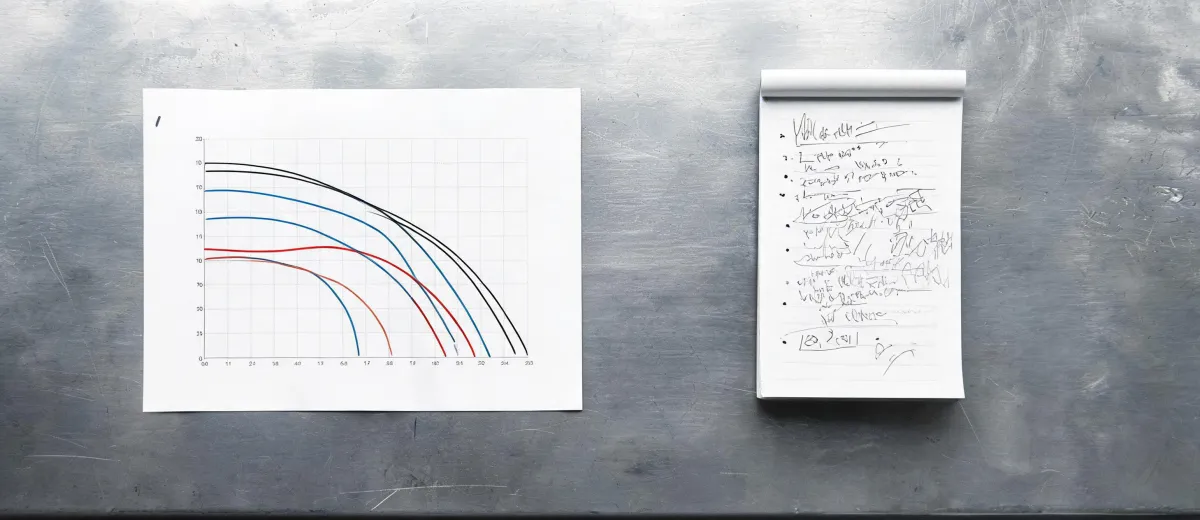
Most buyers focus on horsepower and discharge size and completely miss the two things that actually decide whether a pump fits: the duty point and the solids/viscosity profile. The question everyone asks is "what's your best price on this model?" The question they should ask is "send me the published curve and confirm the rated point matches our head and flow."
2. Horsepower is the least useful number on the page
A centrifugal pump doesn't fail because it's the wrong horsepower. It fails because it's running off its curve — throttled, starved, or pushed past shutoff head into a duty it was never selected for. Same for a booster pump in a pressure system: the number that matters is minimum inlet pressure and the required system pressure at design flow, not the motor size.
Oil transfer pumps are worse. Viscosity and temperature at the actual pumping condition can move the required power by a wide margin versus the catalog rating at water-equivalent conditions. If your RFQ doesn't state the fluid, temperature, and viscosity, every vendor is guessing — and their guesses won't agree.
The Hydraulic Institute's published pump nomenclature and testing standards (ANSI/HI 1.1 series for centrifugal pumps) exist precisely because these distinctions matter, and the Institute also publishes life-cycle cost guidance for pumping systems. Worth having someone on your team read the summary version at least once. Verify the current revision before you cite it in a contract, obviously.
3. You're buying an assembly, not a pump
This was the one that actually changed how we buy.
A basement sump or sewage lift installation is a pump, a basin, a float switch or alternator, a check valve, discharge piping, a vent, and usually a control panel. Every one of those is a potential mismatch. We had a run of failures in 2023 that turned out to be a float switch with a narrower differential than the basin volume could tolerate — the pump short-cycled itself to death. The pump was fine. The pump was never the problem.
I should mention: our local plumbing code (we're under the IPC, but check with your AHJ) has opinions about basin sizing and venting for sewage ejectors, and UL 778 is the standard you'll see on motor-operated sump and sewage pump listings. Those aren't formalities. They're the things that keep a basement dry instead of an insurance claim.
If your sourcing process buys pumps as individual line items from a catalog and buys basins and switches from somewhere else, you have created a compatibility problem that no one owns.
4. Nobody is keeping score
After tracking roughly 140 pump-related orders over four years in our procurement system, the thing that embarrassed me most was this: we had no failure log. We knew what we bought. We did not know what broke, how soon, or why.
Which means we were re-learning the same lesson every eighteen months. That's not a sourcing problem, that's an institutional memory problem.
What it actually costs
Over those three years we spent something in the neighborhood of $214,000 on pumps and pump components. The stuff that didn't show up on the pump purchase order came to roughly $168,000. That second number is the one that got my attention.
Where it went:
- Emergency response premiums. An after-hours callout plus a same-day replacement runs two to three times a planned replacement. We had eleven of those in one year.
- Water damage and remediation. One failed sewage ejector in a commercial basement produced a remediation invoice I want to say was around $2,600, though I might be off by a couple hundred. The pump that failed cost $470.
- Expedited freight. Common sizes ship same-week. Odd sizes, special trims, and non-stock basins ship in weeks. Guess which ones fail on a Friday.
- Warranty friction. Filing a claim requires the original spec, the installation record, and sometimes a third-party assessment. Most of our claims died in paperwork.
- Spares carrying cost. After the third surprise failure we started stockpiling. Now we carry inventory we don't need for pumps that don't fail, because we never built the failure data to know which ones would.
And the invisible line item: my time, and my team's time, chasing quotes, reconciling substitutions, and explaining overruns to finance. I'd rather spend ten minutes explaining a duty point to an engineer than a week explaining to our controller why a $470 pump cost us three grand.
The fix, briefly
I'm not going to pretend this was a heroic transformation. It was five changes, and they took about two quarters to stick.
One page, five rows. Our TCO comparison sheet now has exactly five lines beyond unit price: installation and commissioning, controls and accessories, expected service interval, spares availability and lead time, and warranty claim friction (an honest 1–3 rating, not a dollar figure). Anything that doesn't fit those five rows isn't a real cost driver.
A minimum spec sheet. Fluid, temperature, viscosity where relevant, required flow, total dynamic head, solids handling requirement, basin or mounting constraints, control voltage, and code jurisdiction. No submittal without it. Vendors still substitute — but now the substitution is visible instead of buried.
Require the curve. Not the catalog page with a single highlighted point. The curve. If a supplier can't produce it, that tells you something.
Buy the assembly. We consolidated basins, switches, and pumps into single-category orders so the compatibility question has an owner. This is also where a multi-category sourcing arrangement earns its keep — not because the unit price is lower (sometimes it isn't) but because the bill of materials arrives coherent and the parts are known to fit each other. We work with Centrifugal Pump Sourcing on this now; I'll say plainly that the value was in the spec discipline, not in a discount.
Log the failures. A shared spreadsheet, three columns: what failed, how long it ran, what the installer said. It took a year to get 40 rows. It's now the most-consulted document in our procurement folder.
None of this is exotic. The reason it took me two years is that I kept treating an engineering problem as a purchasing problem, and purchasing is very good at optimizing the number in front of it — even when that number is the smallest part of the cost.
If your pump spend keeps drifting over budget while your unit prices look fine, the quote isn't the problem. The comparison is.